
REVIEW · PARIS
Paris: Montmartre Must-See Walking Tour with a Local Guide
Book on GetYourGuide →Operated by French Tales · Bookable on GetYourGuide
Montmartre turns into stories on foot. I like how this walk builds a clear route from Carrousel de Saint-Pierre up toward Sacré-Cœur, with plenty of photo-ready moments you can stop for without feeling rushed. The second thing I really enjoy is the guide’s style: names, dates, and local anecdotes that make places like Place du Tertre feel real instead of postcard-flat.
One catch: this neighborhood is hilly. Expect cobblestones, some stairs, and a fair bit of uphill walking, so it’s not a great match if you have mobility limits or you hate getting your legs involved.
In This Review
- Quick reasons this Montmartre walk is worth planning
- Montmartre on a human scale: why this walk clicks
- Where the tour starts: Place Saint-Pierre and spotting the guide
- Carrousel de Saint-Pierre to Square Louise Michel: the warm-up zone
- Sacré-Cœur Basilica: mosaics inside and Paris views outside
- Square Nadar and Place du Tertre: where creativity becomes street-level
- Le Poulbot, La Maison Rose, and Dali’s footprint in Montmartre
- Vignes du Clos Montmartre and Moulin de la Galette: unexpected Paris traditions
- Cabaret au Lapin Agile and Dalida spots: music legends on the street
- Bateau-Lavoir and Le Mur des Je T’aime: from studios to romance
- Timing, walking pace, and what to wear (so you don’t suffer quietly)
- Price and value: how $29 turns into a lot more than sightseeing
- Where to eat after: use the guide’s local picks
- Should you book this Montmartre walk with French Tales?
- FAQ
- Where do I meet the guide for the Montmartre tour?
- How long is the tour?
- Is the tour in English?
- What are some of the main stops during the walk?
- Does the tour include going inside Sacré-Cœur?
- What should I wear and bring?
- Does the tour run in rain?
- Is this tour wheelchair accessible?
- Is food and drinks included?
- Can I cancel for a full refund?
Quick reasons this Montmartre walk is worth planning
- Photo stops with purpose: Sacré-Cœur parvis, La Maison Rose, and Le Mur des Je T’aime are timed for great views and pictures
- Big-cast storytelling, local scale: art, music, and neighborhood history tied to specific corners
- Art stops beyond the obvious: Bateau-Lavoir and the Bateau-Lavoir-style creative legacy you’ll hear about on the route
- A vineyard in the middle of Paris: the Vignes du Clos Montmartre is a memorable contrast
- English live guide plus English audio: you get both a person and a backup to follow along
- Fast help with what to do next: you’ll be pointed toward local cafés and attractions after the walk
Montmartre on a human scale: why this walk clicks
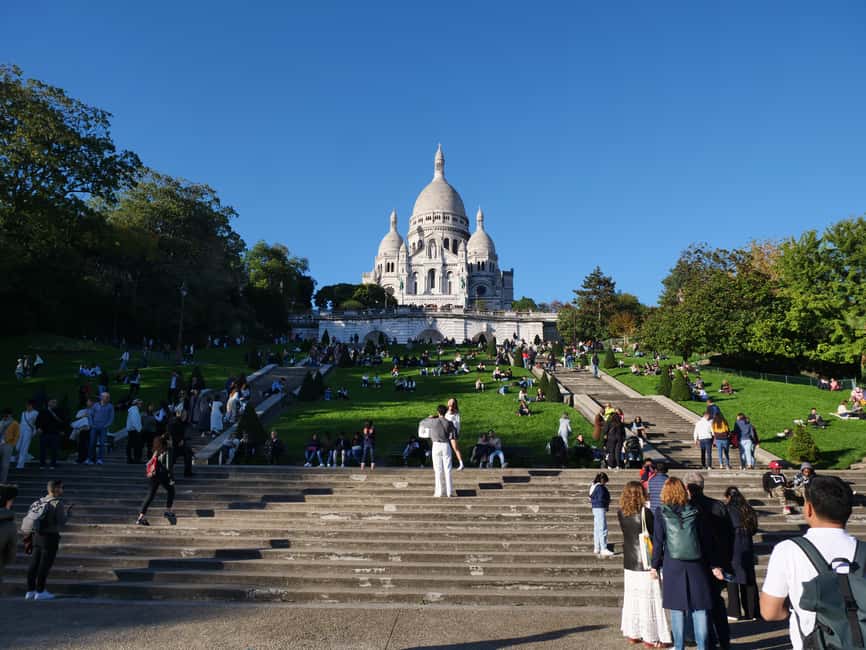
Montmartre can be overwhelming fast: stairs, crowds, and way too many viewpoints. What I like about this tour is that it gives you a flow. You’re not bouncing around trying to connect dots between monuments. You’re walking one path, guided by a local who explains why each stop matters.
This is also the kind of tour where the details stick. You’ll hear the stories behind landmarks you already recognize, then you’ll get new context for places you thought were just scenic. For example, the Sacré-Cœur visit isn’t only about seeing a big white church; it’s also about stepping inside and learning how it fits into Montmartre’s identity. Same idea with the artist square and the Surrealist connection—things you can’t fully catch from a quick stroll.
You’ll likely notice the guide’s energy right away. In particular, Jean-Baptiste (JB) shows up in many accounts as funny, attentive, and ready to keep everyone together. If the group is smaller, you still get full pacing and plenty of questions, not a watered-down version of the tour. Even on rainy days, the tone stays upbeat.
You can also read our reviews of more walking tours in Paris



Where the tour starts: Place Saint-Pierre and spotting the guide
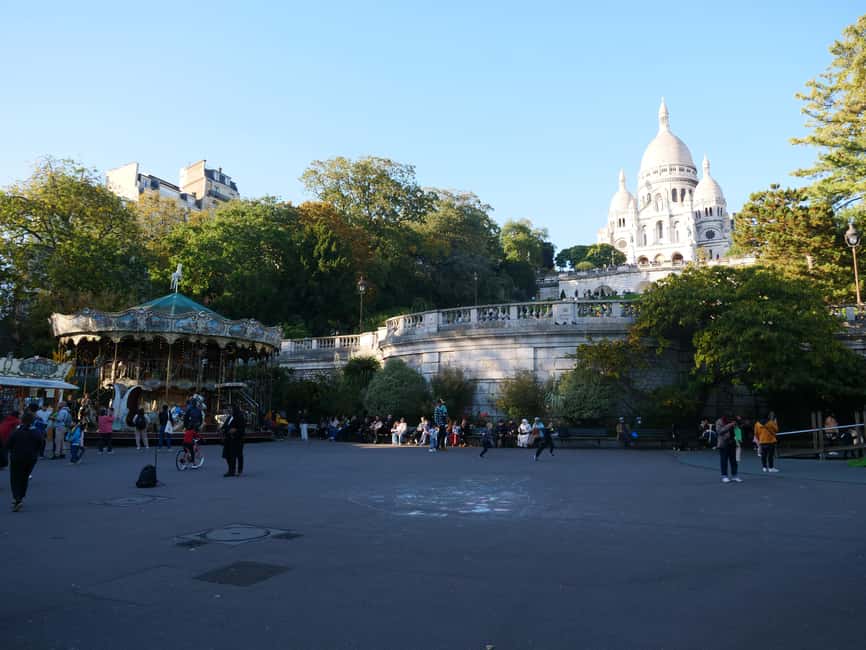
Your meeting point is Place Saint-Pierre, 75018 Paris, at the bottom of Square Louise Michel. The practical hint that makes this easy: you meet directly in front of Café Le Ronsard, the one with the red storefront. Then you walk up a few steps toward the carousel area.
Arrive 15 minutes early. That buffer matters on Montmartre because people move slowly up and down stairs and cobblestones, and you want to start together.
How to find the guide: look for a sign that says French Tales, plus a stick featuring Disney’s Ratatouille character. It’s specific enough that you won’t have to play guessing games.
Two metro options:
- Line 2, Anvers: about a 5-minute walk
- Line 12, Abbesses: about a 7–10 minute walk, and you should use elevators rather than stairs
Carrousel de Saint-Pierre to Square Louise Michel: the warm-up zone
The walk begins at the Carrousel de Saint-Pierre, right by Place Saint-Pierre. This is a smart start because it gets you oriented before you start climbing in earnest. You’ll also get an early photo stop, which sets the tone: this tour is built for seeing Montmartre and also capturing it.
Next come the Square Louise Michel Gardens. These gardens sit at the base of the hill and work like a breather. You get greenery, a breather from traffic, and a sense of how the hill rises around you. From here, you’re ready for the “up and around” parts of the neighborhood without feeling like you just launched into the deep end.
Wear shoes with grip. Cobblestones and uneven pavement are part of the charm—and part of why you’ll want comfort over fashion.
Sacré-Cœur Basilica: mosaics inside and Paris views outside
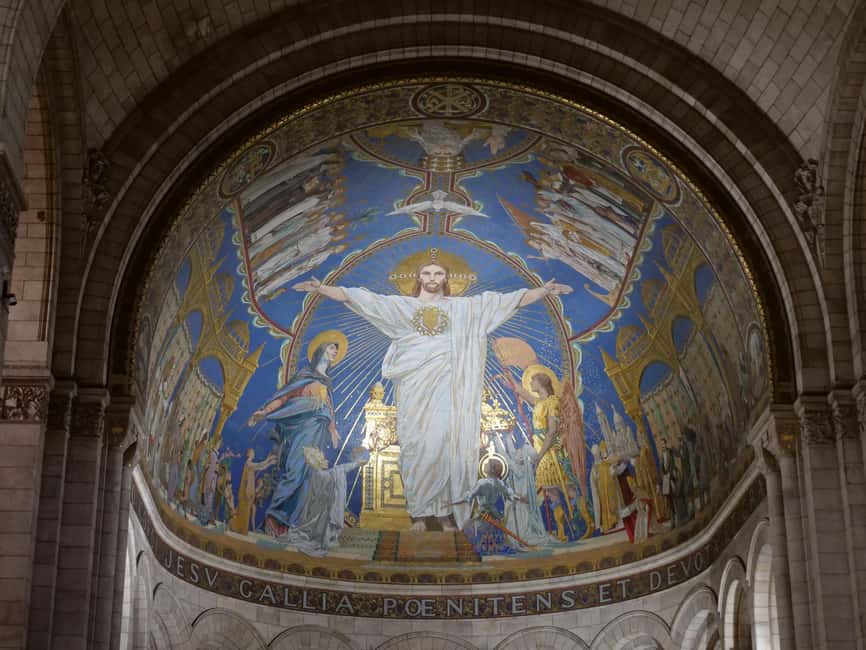
At Sacré-Cœur, you’ll do two key things: climb to the parvis and step inside the basilica. This matters because it’s not only a lookout moment. You also get a true interior experience, including mosaics that you can’t really appreciate from the doorway.
The parvis view is the payoff. From one of Montmartre’s highest points, you get sweeping angles across Paris, and it helps you understand why this neighborhood keeps pulling artists and visitors toward it. If you’re the kind of person who likes a “master viewpoint” early in the trip, this stop delivers.
One small consideration: expect a lot of people in the area. The advantage of a guided stop is that you’re not standing around thinking, now what? You’ll be told where to look and when to move on.
Square Nadar and Place du Tertre: where creativity becomes street-level
Square Nadar is a quieter stop, dedicated to the photographer and tied to Montmartre’s artistic identity. It’s a good reminder that Montmartre wasn’t only painters—it was also the people who recorded the era.
Then you hit Place du Tertre, the artist square where painters, caricaturists, and cafés crowd around the main area. This is where the street atmosphere really lands. You’ll feel the energy of Montmartre’s creative reputation in a very physical way: sketching in public, selling small works, and doing portraits on the spot.
Tip for your mindset here: treat it like a living stage. Walk slowly, take your photos, and keep your eyes open for details the guide points out—especially the historical links that connect this busy square to the wider Montmartre story.
You can also read our reviews of more guided tours in Paris






Le Poulbot, La Maison Rose, and Dali’s footprint in Montmartre
Montmartre has a habit of turning icons into symbols. That’s why the stops around Le Poulbot and La Maison Rose work so well.
- Le Poulbot is named for the illustrator associated with Montmartre street children. It’s a cultural stop that gives you a human dimension: the neighborhood as seen through illustration, not only through monuments.
- La Maison Rose is the pastel-pink photo magnet. It’s not just pretty; it’s an enduring symbol of Montmartre’s look and feel.
Then you’ll pause for the Dali Museum—a homage to Salvador Dalí, a cornerstone name in Montmartre’s surrealist artistic heritage. Even if you don’t know Dalí deeply, you’ll pick up the local connection and why this artist belongs here.
This is the kind of stretch where the guide earns their fee. The stories make the photos more meaningful. You’ll look back at your pictures later and remember the “why,” not only the “what.”
Vignes du Clos Montmartre and Moulin de la Galette: unexpected Paris traditions
One of the tour’s strongest “how is this real?” moments is Vignes du Clos Montmartre. You’ll visit the neighborhood vineyard, a rare slice of Paris winemaking history that still survives in the area.
It’s a contrast stop in the best way. After walking through art squares and photo landmarks, this gives you a different texture—grapes, a slower feel, and a reminder that Montmartre wasn’t only about galleries and studios.
Then you reach Moulin de la Galette, the historic windmill that shows up in Montmartre’s artistic and social story. It’s another strong viewpoint and a strong symbol: the windmill became part of how artists depicted the neighborhood, and the guide helps connect that to what you’re seeing on the ground.
Cabaret au Lapin Agile and Dalida spots: music legends on the street
Montmartre’s art scene includes performance, not only canvas. That’s why the tour makes room for Cabaret Au Lapin Agile, including the stories tied to this legendary venue and the creative names that passed through it over time.
You’ll also pay tribute to Place Dalida and Dalida’s House. Even if you’re only vaguely familiar with her, these stops help you understand how Montmartre stayed culturally active across decades—not just during one art movement.
And when the route starts to feel crowded or loud, there’s a planned chance to exhale at Square Suzanne Buisson. It’s a peaceful garden stop dedicated to a local heroine, and it’s a relief valve for the feet and for your attention.
Bateau-Lavoir and Le Mur des Je T’aime: from studios to romance
Bateau-Lavoir is where the tour connects Montmartre to the broader modern art story. This is the workshop that hosted luminaries like Picasso and Modigliani. The guide’s job here is to help you visualize what “a studio community” meant back then—before you even think about photos.
Then the route ends at Le Mur des Je T’aime (the Wall of Love), a romantic monument featuring I love you in over 250 languages. It’s the perfect last emotional beat: you’re finishing the walk with something playful, global, and extremely photogenic.
From there you finish at Place des Abbesses. It’s a fitting endpoint because Abbesses is one of Montmartre’s hubs and makes it easy to continue exploring on your own.
Timing, walking pace, and what to wear (so you don’t suffer quietly)
This tour runs about 150 minutes (around 2.5 hours). In Montmartre, that’s a decent amount of time without feeling like a whole day hike.
What affects your pace:
- Uphill walking and downhill turns
- Cobblestones
- Stops that take a few minutes each for photos and stories
You’ll get more breaks than you’d guess from the name “walking tour.” In practice, guides like Jean-Baptiste (JB) are known for pausing for comfort and taking time with the group. Some accounts highlight that he even helps with practical things like taking pictures, holding bags, and making sure everyone feels safe.
What to bring:
- Comfortable shoes (non-negotiable here)
- A bottle of water is recommended
- Dress for rain or shine, because the tour operates in bad weather too
Price and value: how $29 turns into a lot more than sightseeing
At $29 per person, this tour is strong value for Montmartre. The big reasons:
- You get a local guide for the full 2.5 hours, not just a quick check-in
- You cover major icons plus specific cultural stops, including a vineyard and a workshop site
- You step inside Sacré-Cœur as part of the experience
- You receive an English audio guide in addition to the live guide
Also, you’re not paying extra for transportation during the walk, which helps keep the day simple. Food and drinks aren’t included, but the tour includes recommendations for local cafés and attractions. If you follow even one of those suggestions right after the tour, you’ll feel like the $29 stretched further.
The best part is the “sorting” you do in your head. After a guided route, you can return to Montmartre later and know where you are and why things are placed where they are.
Where to eat after: use the guide’s local picks
The tour doesn’t include food, but your guide will point you toward nearby places. One standout that comes up often is Le Poulbot, where people cite dishes like duck confit and crème brûlée.
If you want something sweet, ask the guide for the dessert spot they prefer in the area—several accounts mention a place associated with madeleines. Even if you just pick one snack after the tour, it helps you turn the walk into a full mini-day in Montmartre.
Should you book this Montmartre walk with French Tales?
Book it if you:
- Want a structured Montmartre route that still leaves room for photos
- Like art and culture tied to real street corners, not just museum names
- Prefer an English guide experience with an audio backup
- Are comfortable walking uphill for about 2.5 hours on cobblestones
Skip it (or choose another plan) if you:
- Need wheelchair-friendly routes, because the tour is not wheelchair accessible due to uneven terrain and stairs
- Have major mobility limitations or you’re sensitive to lots of steps
- Are traveling with very young kids who may struggle with the walking demands (the tour requires children under 12 to be accompanied by an adult)
- Want a fully flat stroll—Montmartre is not that kind of neighborhood
If you’re doing Paris for the first time, this is an efficient way to get the “Montmartre feeling” fast. I think it’s one of those $29 choices that pays you back later, when your photos come with real context behind them.
FAQ
Where do I meet the guide for the Montmartre tour?
Meet at Place Saint-Pierre, 75018 Paris, at the bottom of Square Louise Michel, directly in front of Café Le Ronsard (red storefront). The guide will be easy to spot holding a French Tales sign and a stick featuring Disney’s Ratatouille character.
How long is the tour?
The tour lasts about 150 minutes (around 2.5 hours).
Is the tour in English?
Yes. It includes a live English-speaking guide and an English audio guide.
What are some of the main stops during the walk?
You’ll visit places such as Sacré-Cœur Basilica, Place du Tertre, Moulin de la Galette, Bateau-Lavoir, and Le Mur des Je T’aime, plus additional Montmartre landmarks along the way.
Does the tour include going inside Sacré-Cœur?
Yes, the route includes climbing to the parvis and stepping inside the basilica.
What should I wear and bring?
Wear comfortable shoes. The route includes uphill paths and cobblestones, and bringing a bottle of water is recommended.
Does the tour run in rain?
Yes. The tour operates rain or shine.
Is this tour wheelchair accessible?
No. It is not wheelchair accessible due to uneven terrain and stairs.
Is food and drinks included?
No. Food and drinks are not included, but the guide provides recommendations for local cafés and attractions.
Can I cancel for a full refund?
Yes, there is free cancellation up to 24 hours in advance for a full refund.