REVIEW · PARIS
Classic 2CV Tour paris 2h
Book on GetYourGuide →Operated by Lapegasebleu · Bookable on GetYourGuide
A 2CV ride is a different kind of Paris. This vintage Citroën 2CV tour brings major landmarks to life with a sunroof and a guide who explains what you’re seeing. I love the slow pace that helps you catch photos from smaller streets and lanes, and I love the way the stops come with practical local context, like how to move between sights afterward (Ahmed is especially noted for this kind of friendly, helpful guidance). One drawback to consider: with just two hours and a return to Champ-de-Mars, it’s sightseeing at a relaxed drive-and-pause pace, not a long museum day.
If you want Paris to feel like a film from the 1940s, this is a fun way to do it. The 2CV is quirky, easygoing, and surprisingly capable on the road, so you can enjoy the ride instead of worrying about every bump. For best results, come with your camera ready and a bit of patience for short stops—this tour is designed for seeing a lot of Paris, not lingering for hours at one spot.
In This Review
- Key points to know before you book
- A Citroën 2CV turns Paris into a street-level story
- Meeting at Champ-de-Mars: start smart, not stressed
- Eiffel Tower moment: the view you remember, with guide context
- From Trocadéro to Arc de Triomphe: big Paris energy, slower than you expect
- Grand Palais and Petit Palais: the museum vibe without the museum day
- Pont Alexandre III and Les Invalides: crossing the city with style
- The Assembly Nationale and Place de la Concorde: the political Paris stop
- Place Vendôme to the Louvre zone: classics, plus the fun of being carried
- Pont Neuf and Notre-Dame: the feel of old Paris with a modern ride
- Luxembourg Gardens to the final return: end with a calmer Paris
- Price and value: what $256 per group gets you
- What’s included, what’s not, and how to plan your day
- Practical tips to make the ride better
- Who this 2CV tour fits best
- Should you book this 2CV tour?
- FAQ
- FAQ
- How long is the Classic 2CV Tour Paris (2h)?
- What is the price and group size?
- Where does the tour start and end?
- Is hotel pickup included?
- What is included in the tour?
- Are meals or drinks included?
- What languages are available for the live guide?
- Is smoking allowed?
- Can you eat or drink in the car?
- What should I bring?
- What are the cancellation terms and booking options?
Key points to know before you book
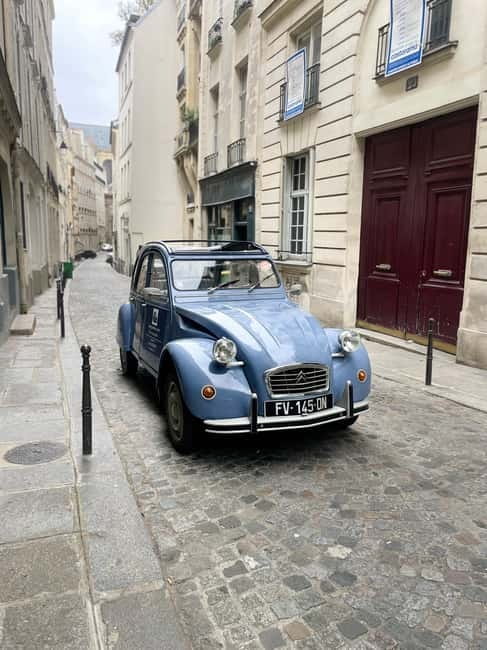
- A vintage 2CV experience, open to the sky with a sunroof for better views while you move through town
- Private group up to 3, so it feels personal instead of crowded
- Guided pauses at heavyweight landmarks like the Eiffel Tower, Arc de Triomphe, and Notre-Dame areas
- Photoshoot included, plus lots of natural photo angles from the car and the stops
- A guide-led route with practical local history, including tips for getting around Paris afterward
- Hotel pickup is listed, but the tour ends back at Champ-de-Mars, behind the Eiffel Tower
A Citroën 2CV turns Paris into a street-level story
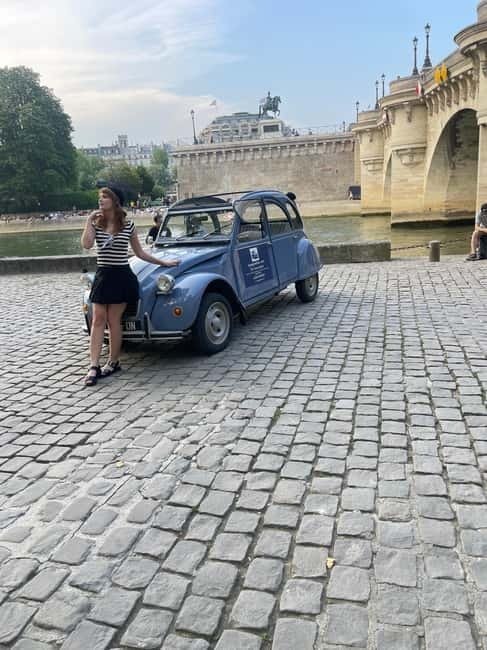
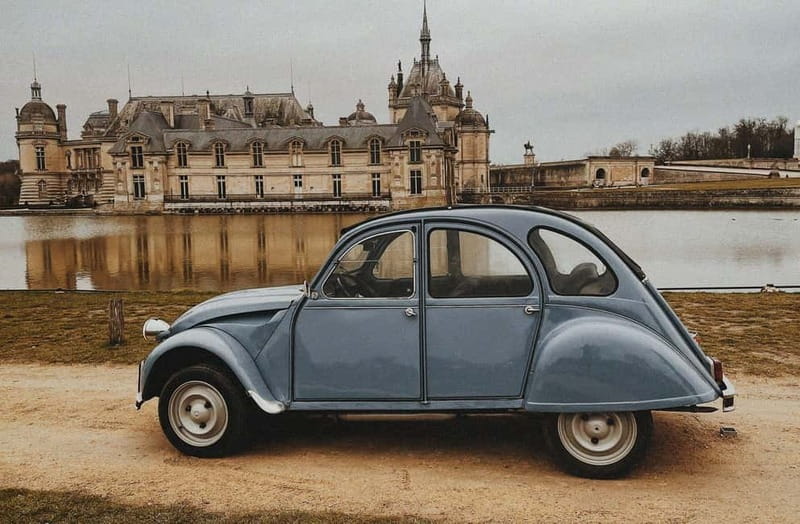
Paris is easy to over-plan. This tour is the opposite. You get a simple, old-school ride in a classic Citroën 2CV, produced from 1948 to 1990, and you experience the city at human speed. The sunroof matters more than you think: it keeps the air and the sky in the mix, which makes even well-known buildings feel less like a checklist.
I also like how the car’s reputation for practicality shows up in the experience. The 2CV was built to handle rough roads with a forgiving feel, so you’re not constantly bracing. Instead, you can look up, turn your head toward the next view, and let the guide do the connecting-the-dots work between monuments, neighborhoods, and major boulevards.
This kind of tour is perfect if your idea of “value” is time saved and context gained. You’re not just driving past famous places; you’re getting a guided rhythm: stop, learn, look, take photos, then glide on to the next highlight.
You can also read our reviews of more tours and experiences in Paris


Meeting at Champ-de-Mars: start smart, not stressed
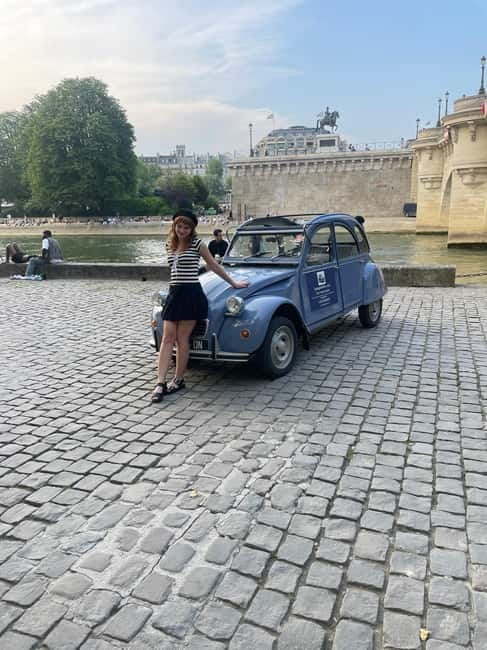
The tour meets at Champ-de-Mars, behind the Eiffel Tower. That’s a great starting point because you’re already in one of the most iconic “center” zones of the city, and it’s easy to build your day around before and after the ride.
Here’s the key logistics point: while pickup from your hotel is listed as included, the tour ends back at the meeting point. So if you’re imagining a door-to-door round trip, adjust your plan. After the drive, you may need to get yourself back to your hotel.
Arriving 10 minutes early is a good move. You’ll want a smooth start so the guide can get you into the flow quickly. If you’re traveling in warm weather, bring the hat and sunscreen mentioned for sunny days; open-air time tends to add up fast, even when you’re moving slowly.
Eiffel Tower moment: the view you remember, with guide context
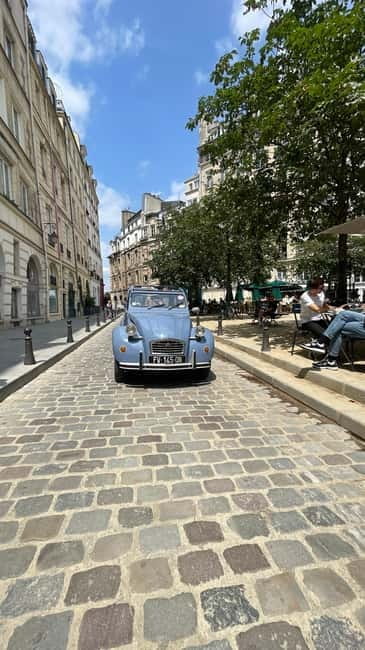
The first big stop is the Eiffel Tower area right from your starting zone. The guide’s job here is simple but important: help you see the tower beyond the postcard look. You’ll get a guided pause where you can take photos and orient yourself to how the Eiffel Tower fits into the surrounding geometry of Paris.
Then the route continues toward the Trocadero Gardens, which are a classic spot for Eiffel Tower angles. This is where the 2CV format shines. You’re not walking long distances in big crowds; you’re pausing, looking, and shifting position in a way that feels easier on your feet.
If you want one practical tip, it’s this: treat the first third of the tour as your framing time. By the time you reach the major “signature” monuments later, you’ll already have a better sense of direction and distance, which makes the rest of the ride feel less like a blur.
From Trocadéro to Arc de Triomphe: big Paris energy, slower than you expect
After the Eiffel Tower and the Trocadéro side, you head toward the Arc de Triomphe. This stop is all about scale and symbolism, and it’s the kind of place where a short guided explanation can change what you notice. Even if you’ve seen photos before, it helps to understand why the monument sits where it does and how it connects to the city’s wide ceremonial axes.
From there, you move into the Champs-Élysées zone with time for a guided look. The Champs-Élysées can feel intimidating if you’ve only seen it from a distance, but from the comfort of a small car and with a guide pointing out what matters, it becomes more manageable. You’ll get the feeling of a boulevard designed for visibility, not quiet exploration.
The 2CV also helps here. It’s not a vehicle you’re used to in Paris, so the ride slows your brain down. That’s good. You’ll spot details you’d normally miss while marching from one landmark to the next.
Grand Palais and Petit Palais: the museum vibe without the museum day
Next up are two major “look and learn” stops in the Grand Palais and Petit Palais area. Even if you don’t go inside, these buildings are worth seeing for their design language and the way they shape the street around them. A good guide makes the difference between a pretty façade and a place with meaning.
This is also where the photoshoot component starts to feel practical. You’re already traveling in a 2CV, so you’ll naturally get those framed shots that look like Paris with a soundtrack from another era. Then your photo time at the stops gives you a chance to capture the architecture up close, instead of only at moving-car speed.
If you have a friend or partner who needs reassurance that they won’t get bored, this part helps. You’re not spending the afternoon trapped in museum queues. You’re seeing the city’s “stage set” from the outside and learning why it looks the way it does.





Pont Alexandre III and Les Invalides: crossing the city with style
Then you reach Pont Alexandre III, a bridge stop that’s made for noticing. Bridges are where Paris stops being just landmarks and starts being routes—connections. A guided pause here helps you read the city as a set of linked views rather than separate attractions.
After that, you head toward Les Invalides. This is another “more than a photo” stop. Even if you only have a quick view, you’ll likely come away with a clearer sense of how this area fits into France’s wider story. And because you’re moving via 2CV, you’re getting a gentle transition between districts instead of switching trains, rerouting, or fighting logistics.
The value of this phase is momentum with structure. You keep seeing big sights, but you’re also getting enough explanation to make the stops feel connected rather than random.
The Assembly Nationale and Place de la Concorde: the political Paris stop
Next come l’Assemblée Nationale and Place de la Concorde. These aren’t just scenic stops; they’re reminders that Paris isn’t only art and cafes. It’s also government, public space, and the power of major plazas.
A guided pause at this stage helps you understand what you’re looking at and why you’re there. Place de la Concorde is one of those wide open areas that can feel confusing if you’re only passing through on foot. Seeing it with direction and commentary makes it easier to track where you are and what the plaza represents.
From here, you continue toward Madeleine, then the Opéra area. Those transitions matter because they teach your eyes how to read Paris streets. You start noticing how buildings and streets shift in style, and you get a sense of the city’s “layers” moving through time.
Place Vendôme to the Louvre zone: classics, plus the fun of being carried
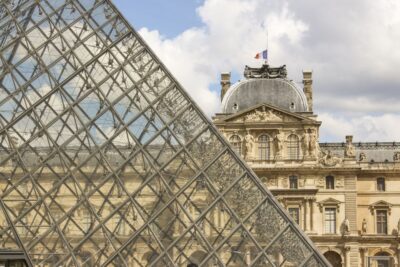
Place Vendôme is next, and it’s a strong “center” location for classic Paris views. Then the route includes the Louvre Museum area, one of the places everyone knows and almost everyone rushes. A short guided stop here is a good reminder: you can experience the mood of a landmark without needing hours of museum time.
A key benefit of this type of tour is that it helps you avoid the all-day freeze. If you’ve ever planned a full day around one museum and then spent the rest of the day tired and behind, you’ll appreciate this format. You get the Louvre zone in a guided, photo-ready way, and then you’re moving on while your energy is still high.
The 2CV route keeps you from mentally loading your day. You don’t have to decide where to go next, because the guide does it for you.
Pont Neuf and Notre-Dame: the feel of old Paris with a modern ride
After the Louvre area, you cross to Pont Neuf. Bridges again are about connections, and this one is a good spot to slow down and notice the view lines. Then the tour brings you to Notre-Dame Cathedral.
This is one of the emotional heart points of the route. Even if your photos look like a postcard, the guided context helps you notice the cathedral’s presence in the city’s flow. You’re also not doing the full walking circuit that many self-guided routes require, which means you can focus on what you came for: the feeling of being in the historic core.
The next stop is the Latin Quarter, followed by the Pantheon. That pairing works well because it shifts you from one kind of historic landmark to another. The Latin Quarter area gives you that lived-in student-and-scholars vibe, while the Pantheon adds a more formal monument atmosphere.
Luxembourg Gardens to the final return: end with a calmer Paris
The last major stop is Luxembourg Gardens, a softer finish compared with the earlier boulevard intensity. A garden stop also gives you a break from “look up at monuments” and gives your eyes a change of pace.
Then you return to Champ-de-Mars behind the Eiffel Tower. That wrap-up matters: you end where many visitors want to be anyway, so your evening plans stay easy. If you still want more exploring after the tour, you’ll have the city’s layout in your head in a way that helps you choose your next neighborhood without second-guessing.
The best part is how the route teaches your brain. After this, Paris doesn’t feel like a random map of spots. It feels like a connected set of places you can navigate.
Price and value: what $256 per group gets you
The price is $256 per group up to 3 for a two-hour experience. On paper, that’s not the cheapest way to see Paris. But you’re paying for three things that add up:
1) Private time in a vintage 2CV, not a shared bus ride
2) Guided storytelling at many landmarks, which saves you from researching each stop
3) A photoshoot included, plus photo-friendly positioning from the car and stops
If you’re traveling as a small group, the math gets more appealing. Even with a single couple, you’re effectively splitting the cost across people rather than paying a per-person museum-ticket style price for a short outing.
Where I think the tour is most valuable is when you care about the experience style—old car, open sky, guided pauses, and not having to run across Paris like a sprinting tourist.
What’s included, what’s not, and how to plan your day
Included features are clear and useful: guided tour in a vintage 2CV, a photoshoot, pickup from the hotel, and music during the ride. That music detail may sound small, but it makes the car feel like a real experience, not just transport.
Not included: meals and drinks. Also, the tour ends back at Champ-de-Mars, so you should plan your own way back to your hotel after the ride if you’re not already nearby.
A practical way to schedule your day: treat this as your “orientation + highlights” block. Do it earlier in your trip if possible. You’ll come out with a mental map and a better idea of which neighborhoods you want to revisit later.
Practical tips to make the ride better
Bring a hat, your camera, and sunscreen—these are directly recommended for sunny days. The sunroof means you’ll feel the weather more than you would in a closed vehicle.
You’ll also want to plan around the rules: no smoking, and consuming food and drinks in the car isn’t allowed. That keeps the experience clean and comfortable, but it also means you should grab snacks beforehand or plan a quick café stop outside the car.
Finally, dress for the light change. You’ll be moving between shaded streets, bright monuments, and open viewpoints. Comfortable shoes still matter, because you’ll likely be walking a few steps at stops and from the car to viewpoints.
Who this 2CV tour fits best
This tour is a strong match if you:
- want a guided way to see big Paris landmarks without doing long museum hours
- like photo moments and quirky transport
- prefer a slower pace and a private group vibe
- enjoy history told in a practical, moving format rather than as a textbook lecture
It’s not the best match if you need lots of time at one single monument or you’re hoping for a full deep-dive into interiors. This is designed to show you the city’s key scenes and connect them through a story.
Should you book this 2CV tour?
Yes, if you want Paris in a small-group, old-car format with guided context and lots of photo-ready moments in just two hours. I’d especially recommend it early in your trip when you’re still building your bearings.
Skip it if your top goal is long, detailed time inside museums or if you’re only interested in one neighborhood. The route covers many of the headline areas, so you’ll get variety, not single-site hours.
If you can sync your expectations to a relaxed drive-and-pause style, you’ll likely walk away thinking the city looks different when you meet it slowly—through a tiny car, under an open sky.
FAQ
FAQ
How long is the Classic 2CV Tour Paris (2h)?
It lasts 2 hours.
What is the price and group size?
The price is $256 per group up to 3 people.
Where does the tour start and end?
It starts at Champ-de-Mars behind the Eiffel Tower and ends back at the same meeting point.
Is hotel pickup included?
Hotel pickup is listed as included, but the activity ends back at Champ-de-Mars (hotel drop-off is not listed as included).
What is included in the tour?
Included items are a guided tour in a vintage 2CV, photoshoot, hotel pickup, and music.
Are meals or drinks included?
No. Meals and drinks are not included.
What languages are available for the live guide?
The live guide is available in French, English, Arabic, and Hungarian.
Is smoking allowed?
No, smoking is not allowed.
Can you eat or drink in the car?
Consuming food and drinks in the car is not allowed.
What should I bring?
Bring a hat, a camera, and sunscreen.
What are the cancellation terms and booking options?
You can cancel up to 24 hours in advance for a full refund. There’s also a reserve now & pay later option.