REVIEW · PARIS
Paris: Famous Monuments Cycling Tour
Book on GetYourGuide →Operated by Bike About Tours · Bookable on GetYourGuide
That bike ride hits the big-ticket sights fast.
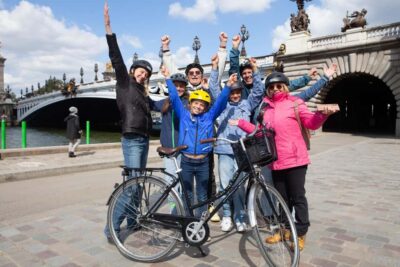
This Paris monuments tour turns classic landmarks into a moving, street-level experience, with guiding on the ground and a route that’s mostly on bike paths. I especially like that you get close-up angles you just don’t get from a hop-on-hop-off bus.
You’ll love the mix of Seine-side history and practical comfort: smooth riding for a flat route (about 13 kilometers) plus stops for photos and context. I also like the way it strings together the Louvre area, Les Invalides, and the Eiffel Tower into one connected loop. The main drawback to consider: if you’re hoping for a fast, mostly-spectacle tour, some of the storytelling can feel long, and the route may repeat certain stretches instead of branching far out to places like Montmartre.
In This Review
- Key highlights at a glance
- Starting at Le Peloton Café in the Marais
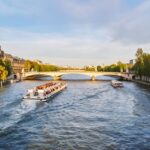
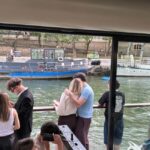
- Notre-Dame Island to Palais de Justice: the Seine at street level
- Pont des Arts and the bridge lesson you’ll remember
- Louvre courtyards, pyramid framing, and quick Orsay-area views
- Les Invalides and Place de la Concorde: Napoleon’s shadow
- Rue Cler pastry break: a practical stop that keeps energy high
- Eiffel Tower close-up on bike lanes (and why it matters)
- Grand and Petit Palais, then Arc de Triomphe and the Champs-Élysées
- The ride back: tunnels and a riverside finish
- Price and value: what $113,875 per person means for your decision
- Who this tour fits best (and who should skip it)
- Should you book this Paris monuments cycling tour?
- FAQ
- How long is the Paris Famous Monuments Cycling Tour?
- Where do we meet, and where does the tour end?
- What’s included in the price?
- Is food or drinks included?
- Do I need to know how to ride a bike?
- Is the route flat or hilly?
- What language is the tour guide?
- What should I bring for the tour?
Key highlights at a glance
- Le Peloton Café base in the Marais for an easy start near old Paris streets
- Notre-Dame to Pont des Arts with classic island views and bridge lore
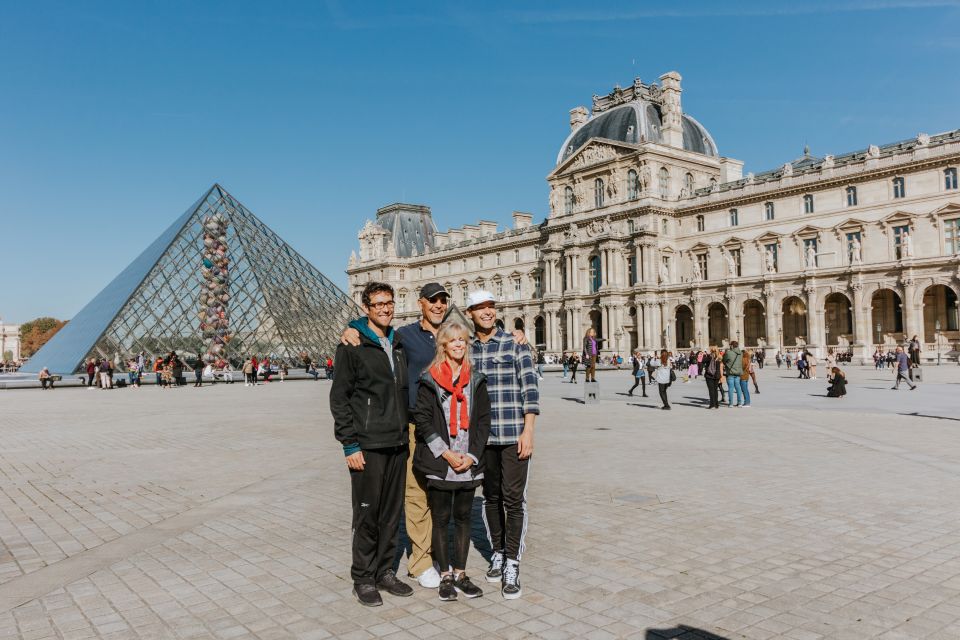
- Louvre courtyards with pyramid framing (family photo-friendly stops)
- Rue Cler pastry pit stop before rolling toward the Eiffel Tower
- Bike lanes plus riverside finish that keeps you moving and reduces street stress
Starting at Le Peloton Café in the Marais
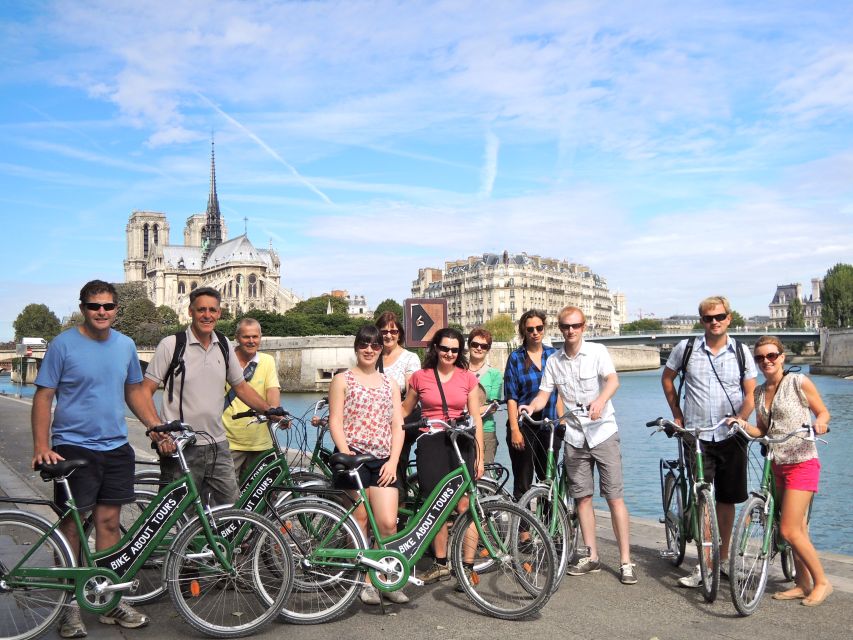
Your tour begins at Le Peloton Café, in the Marais at 17 rue du Pont Louis-Philippe. This is a smart starting choice because the Marais feels like real Paris street life before you zoom into the postcard areas. You meet your guide, get fitted with the right bike (and helmets are provided if you want one), then roll out as a group.
What I like most here is the setup. Instead of scrambling for directions near major sights, you start with a calm base in a neighborhood that’s already fun to wander. It also means the first minutes aren’t spent fighting traffic—your guide gets you organized and rolling at a good pace.
One practical note: the tour is designed for people who can ride. If you’re wobbly or you avoid hills, this isn’t the right setting to learn.
You can also read our reviews of more cycling tours in Paris

Notre-Dame Island to Palais de Justice: the Seine at street level
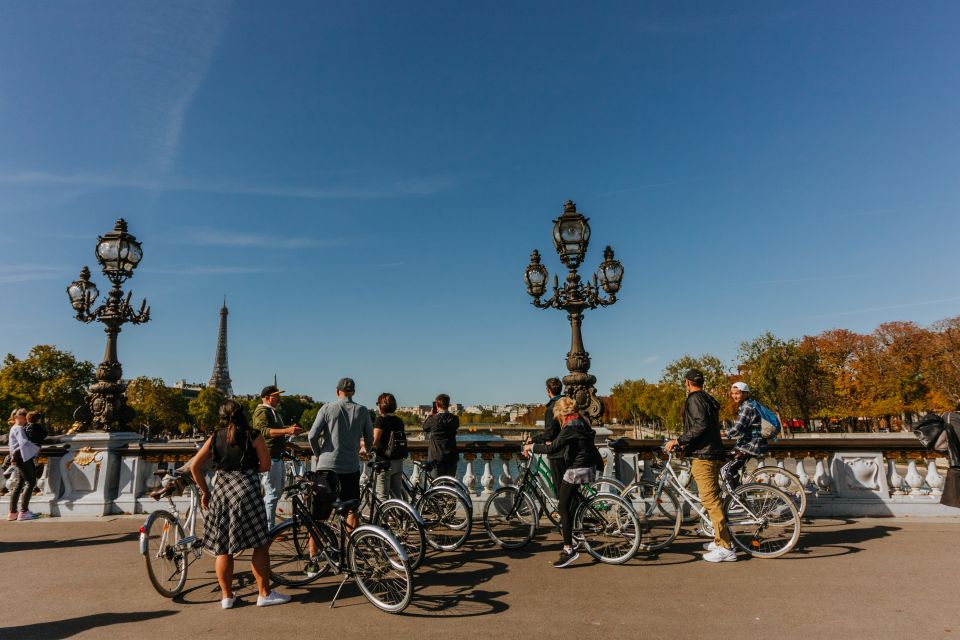
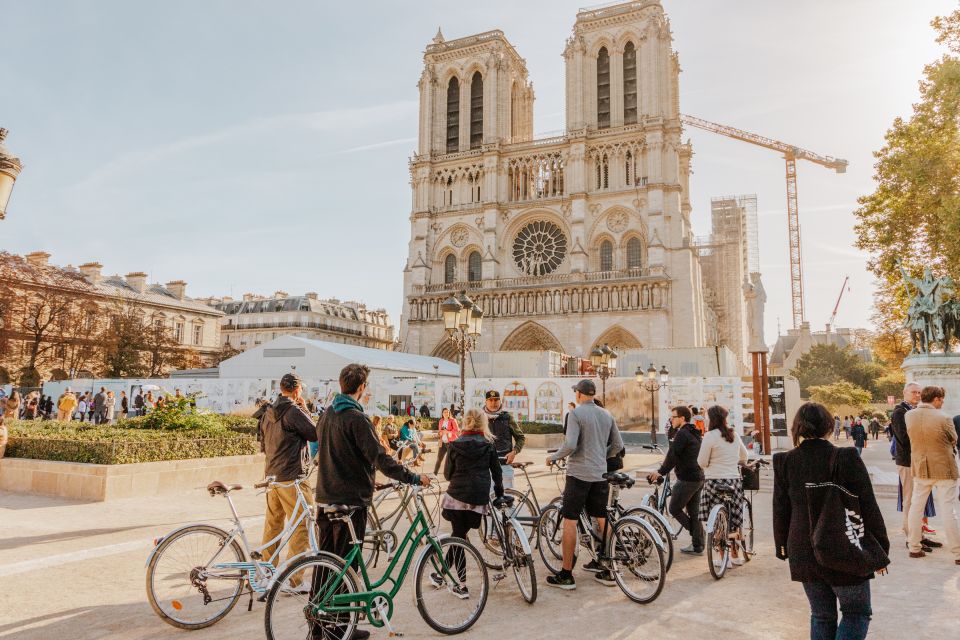
Once you cross into the area of the islands just across the river, the first big sight is Notre-Dame. You don’t just see it—you get the history thread, including the way it was shaped by construction and reconstruction. Seeing that context while you’re already on the water’s edge makes the stories click, because you’re literally in the landscape where those changes played out.
From there, you curve around the island past a local flower market, then continue toward the Palais de Justice. This stretch is great for photo stops because the views are layered: buildings, bridges, and river angles all work together. It’s also one of the parts of the route where the biking feels most like a sightseeing walk, just faster.
Then you pass into the Latin Quarter area and ride by Fontaine Saint-Michel. Even if you’ve seen it before, the timing matters—you catch it while your guide is building the “map” of where you are in Paris.
Pont des Arts and the bridge lesson you’ll remember
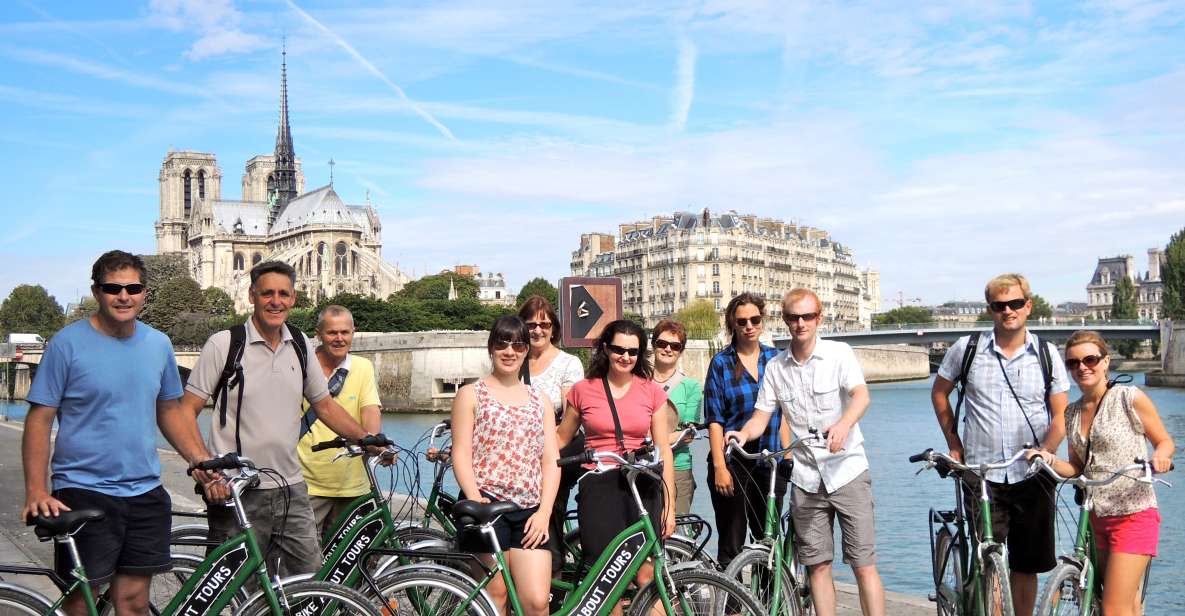
After Fontaine Saint-Michel, you reach Pont des Arts, known as Paris’s first lock bridge. This stop is more than a quick photo moment. Your guide ties the bridge story to why Paris has so many distinct crossings and how they function in the city’s layout.
You’ll also hear about the Institute of France in this area. That may sound like academic trivia, but it helps you understand why certain buildings and viewpoints feel important beyond just being scenic. When you’re on a bike, you can notice details you’d skip on foot—like the way a bridge frames the river and pulls your line of sight toward the next major landmark.
If you enjoy architecture and city design, this portion is a standout. If you’re more in a “fast highlights only” mood, it’s the kind of moment where the guide’s explanations can take extra time. It’s worth it, but it won’t be the shortest stop.
Louvre courtyards, pyramid framing, and quick Orsay-area views
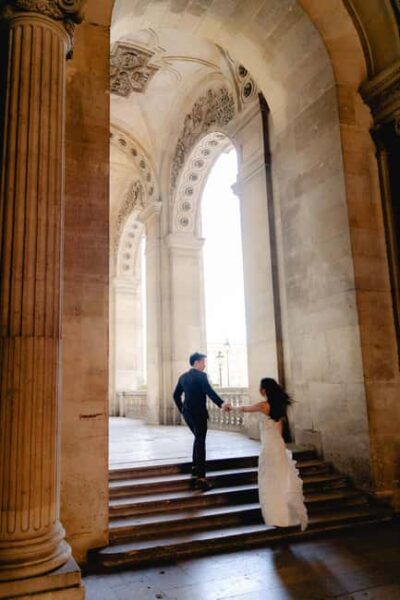
Next comes one of the most satisfying segments: getting to the Louvre courtyards. Rather than treating the museum like a far-off icon, you enter through a back entrance and ride the older courtyard surfaces. The vibe here is different from the busy main approaches—more “Paris behind the scenes,” with cobblestones and courtyards that feel built for strolling as much as architecture spotting.
You’ll then glide through archways toward the larger courtyard where you get a clean view of the Louvre pyramid. This is the kind of framing that makes you stop even if you’ve seen it in photos a hundred times. From the bike, your angle changes in real time, so it feels less like posing and more like “oh, that’s how it really sits in the space.”
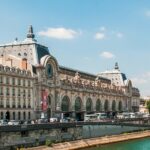
After that, you continue with views toward the Tuileries Garden and Musée d’Orsay. You may not spend long at each spot, but you’ll get a sense of how Paris lines up its great museums along the river corridor. That’s the real value of this tour style: it stitches together landmarks into one mental map.
Les Invalides and Place de la Concorde: Napoleon’s shadow
Then it’s time for Les Invalides, with a key passage through Place de la Concorde. This square carries a heavy contrast. Long ago, it was linked to executions—the guillotine era—and today it’s dominated by an Egyptian obelisk. Your guide gives you that connection as you ride through the space, so it doesn’t stay abstract.
After you cross the Alexander Bridge, you approach Les Invalides head-on. This is where the tour leans into one of Paris’s most iconic “gravity moments.” The site is famously associated with Napoleon Bonaparte’s resting place, and your guide explains the significance as you get your first real view up close.
This segment works well because the ride itself changes your perspective. From a bike lane angle, you can see how the monumental buildings sit relative to the river. It’s not just history as a lecture; it’s history as orientation.


Rue Cler pastry break: a practical stop that keeps energy high
A big reason this tour feels fun rather than exhausting: there’s a planned pit stop on Rue Cler. This street is a strong choice because it’s pedestrian-focused and packed with snack opportunities—perfect for grabbing something without losing the day to logistics.
Since food isn’t included, you’ll have to buy what you want. But the tour gives you the time and location that make it easy to do so. If you want a crêpe or an éclair, this is your moment to do it.
I like Rue Cler on bike tours because you get the Paris flavor without needing museum tickets or long lines. It also resets the group after big landmark stretches, so you roll back toward the Eiffel Tower feeling ready.
Eiffel Tower close-up on bike lanes (and why it matters)
Now for the main star: the Eiffel Tower. You’ll pedal through the area and get views that feel closer and more immersive than typical viewpoints, because you’re moving along the right side streets and bike routing instead of standing behind barriers.
You’ll ride alongside Paris’s most famous landmark until you reconnect with the bike path to cross back over the river. What I like here is that your guide times the ride so you get those “film-still” moments, but you’re still actively traveling rather than just waiting around.
This is also where the tour’s promise about newer bike lanes becomes real. Paris can be intimidating on a bike if you’re stuck in mixed traffic. On this route, you spend more time on bike infrastructure designed for cyclists, which makes the whole day easier to enjoy.
One caution: if you’re expecting a long Eiffel Tower viewpoint session, this tour is built more for motion and connection than for extended standing time. The goal is the loop—so enjoy the angles, take your photos, and keep rolling.
Grand and Petit Palais, then Arc de Triomphe and the Champs-Élysées
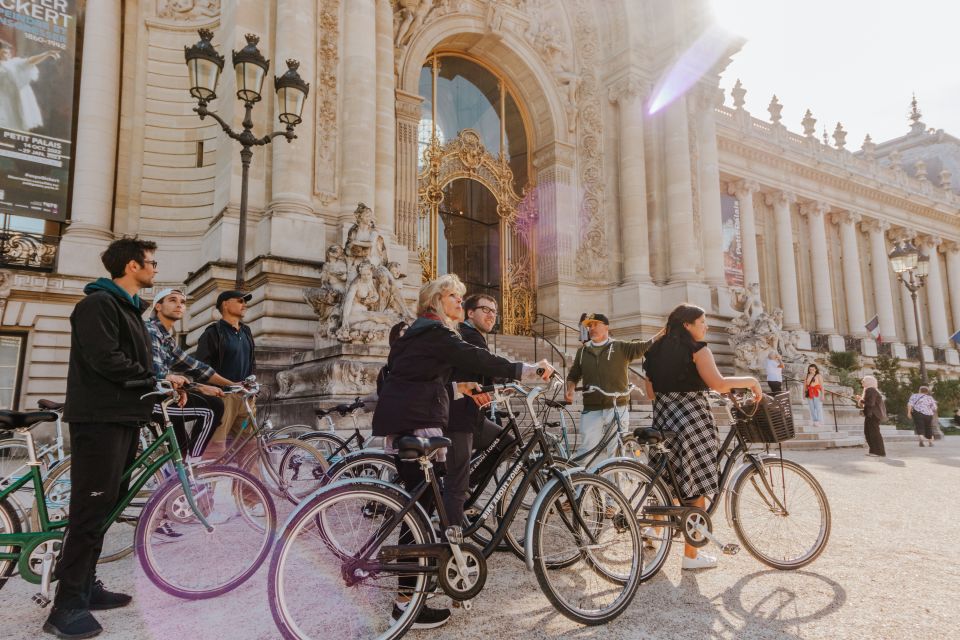
On the return, you get another run of famous Paris icons. You’ll pull into areas near the Grand Palais and Petit Palais, where your guide connects them to World Fairs held in Paris. These stops are quick but meaningful. The palaces can look like pure beauty from the outside, yet the fair-era context helps you see why they exist as they do.
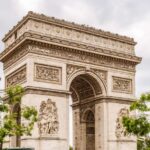
Then you get a photo op area at Arc de Triomphe and ride through the broader Champs-Élysées corridor. This part is visually iconic, but here’s the balanced note from how the route tends to feel: if you love variety and want to branch into lesser-visited neighborhoods, you might notice the tour keeps you within the big central artery. Some people may wish the route pushed farther to other quarters.
On balance, I still like it because Champs-Élysées and Arc de Triomphe are hard to “get” from a normal stroll unless you already know the layout. The bike adds scale. You feel how the avenue behaves in real space.
The ride back: tunnels and a riverside finish
The tour concludes with something that feels almost like a theme park detail: two fun tunnels and then a ride along the Paris riverside. That riverside finish is a nice payoff because it puts you back into the Seine rhythm, after all the monumental stops.
This is also one of the most comfortable parts of the day. By the time you’re riding back, you’ve already seen the hardest landmark names, and you’re mostly in “enjoy the ride” mode. It’s a good way to close so you don’t end the tour with fatigue and a scramble to get back to transit.
If you like city photos, plan your camera habits here. The river angles and tunnel entries can create great frames, and you’ll have momentum rather than long walking breaks.
Price and value: what $113,875 per person means for your decision
The listed price shows $113,875 per person, which is extremely high compared with what most people expect for a 3.5-hour city bike tour. I’d treat that number as a “pause and verify” situation. Confirm what’s actually included (the basics are clear: a tour guide, plus bikes and helmets if desired) and check what else might be tied to that total in your booking flow.
At this duration—about 3.5 hours—you’re not paying for a full-day transportation service. You’re paying for a guided route that strings together major sights with mostly-bike-path routing, built-in stops, and a guide who explains what you’re seeing as you ride.
So here’s how I’d judge value:
- If you want big landmarks connected by bike lanes and you’ll actually use the guide’s stories, the tour can be worth it.
- If your style is “short stops, fast photos, minimal talking,” the price makes it even more important that you like guided explanations and you’re comfortable riding steadily for around 13 kilometers.
Also, food isn’t included, so budgeting for a pastry at Rue Cler and any drinks will be on you.
Who this tour fits best (and who should skip it)
This is a good fit if you:
- can comfortably ride a bike and want a flat, straightforward route
- love landmark variety in one loop: Notre-Dame, Louvre courtyards, Les Invalides, Eiffel Tower
- enjoy guided context while moving—especially bridge and monument explanations
- want to use Paris bike infrastructure instead of fighting mixed traffic
It’s not the best fit if you:
- don’t ride bikes confidently (it’s explicitly not recommended for people who can’t ride)
- want a tour that pushes far beyond central monuments into other distinct neighborhoods
- prefer very short story stops and mostly spectacle
The route is designed with stops for photos and history, so the pacing isn’t built to feel like a nonstop sprint. That works well for many people, but it’s worth matching your expectations.
Should you book this Paris monuments cycling tour?
If you’re choosing between a standard walking tour and a bike loop, I’d pick this one if you want the landmarks connected like a film sequence—Seine first, Louvre next, then Les Invalides and the Eiffel Tower, with a smart pastry break on Rue Cler. The biking angle is the point: you get close-up views, you move efficiently, and you avoid turning every major sight into a long transit-and-wait routine.
But if the price alone makes you nervous, or if you’re the type who wants a wider neighborhood spread (instead of staying in the central monuments corridor), look closely at what you care about most: guide storytelling, bike-lane comfort, and that classic Paris loop.
FAQ
How long is the Paris Famous Monuments Cycling Tour?
The tour lasts about 3.5 hours.
Where do we meet, and where does the tour end?
You meet at Le Peloton Café at 17 rue du Pont Louis-Philippe in the Marais, and the tour ends back at the same meeting point.
What’s included in the price?
The tour includes a tour guide and bikes and helmets (if desired).
Is food or drinks included?
No. Food and drinks are not included, though there is a stop on Rue Cler where you can buy snacks.
Do I need to know how to ride a bike?
Yes. This tour is not recommended for people who do not know how to ride a bike.
Is the route flat or hilly?
The route is flat and runs for about 13 kilometers, with most of the journey spent on bike paths.
What language is the tour guide?
The tour guide is available in English.
What should I bring for the tour?
Bring a hat and gloves. If you book during colder months, pack layers as well.